


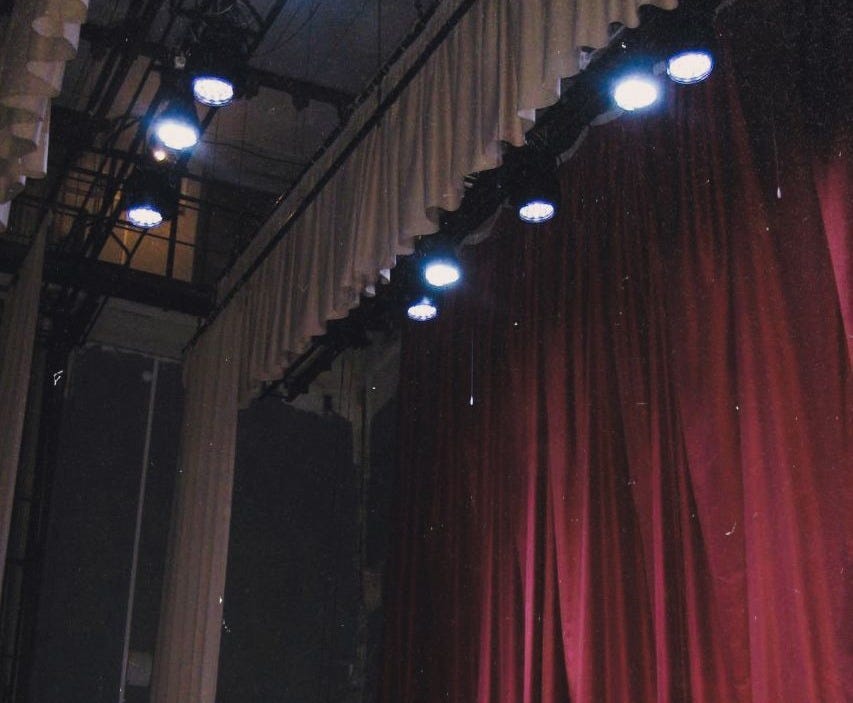
Every "professional" theatre person—every understudy, every swing, every dresser, every stage manager, every casting director, every Tony winner—came from a different-kind-of-same place.
A small auditorium on a Saturday night. And that's not a metaphor.
It's a song from All the World's a Stage. And literally your cousin's backyard. Your temple's basement. Your middle school cafetorium with the basketball nets cranked up to the ceiling.
The thing we call the industry—the thing with the Playbill and the reviews and the Tonys and the cast recordings and the TikToks—doesn't exist without those rooms. Not "is harder without them." Doesn't exist.
We talk about Broadway as the apex. Regional as the farm system. Community theater as a hobby. The conversation runs top-down, from marquee back to middle school.
But maybe the river starts in the small auditorium. The marquee is just the mouth—wider, louder, visible from further away. But the water is coming from somewhere else.
This week, let's go there.
Amateur Hour
Broadway isn't, by and large, a room full of amateurs.
But the thing Broadway pays millions of dollars to re-create—the electricity, the ensemble Love, the feeling that the show matters, that something is at stake for everyone in the room—is sitting in a high school auditorium with a broken AC. Unglamorous. Uncommodified. "Amateur."
Turns out, the word amateur comes from the Latin amare. It means one who Loves.
So when someone says "it's just community theater," what they're literally saying is: "it's just a room full of people who Love this."
That's a strange label to use as a downgrade.
Broadway, by contrast, is a room full of professionals—which is its own beautiful, hard-won, worthy thing. But professional means "one who is paid." Which means, necessarily, that some of the Love has to get re-routed through the market. Through the agent. The contract. The rent. Nobody's fault. Just the math of having to eat.
The small auditorium on Saturday night doesn't have a market to route through. Which means what's happening in that room is, technically, the purest version of the thing.
The industry's job, at its best, isn't to transcend that. It's to stay close to it. To remember where the water came from.
Downstream
It's easy, downstream, to step in the water and forget it has an origin.
We tend to do that to ourselves too.
The brain is not an archive. Memories aren't filed away like photographs—they're rebuilt each time you need them. From fragments. Stitched together with whoever you are now.
Neuroscientists call this reconsolidation. Every recall alters the memory. The original fades. What remains is the most recent telling.
Which means the kid who first sat in a theater, breath held, watching something come alive—that kid isn't preserved. That kid is rebuilt, each time, by whoever you've become. Through whatever distance you're willing to travel.
And the distance is the whole thing.
Because if you could remember clearly—if you could get back down into the same body, the same torn fabric seats, the same held breath—you'd realize you were standing in the same water.
The upgrade isn't a fact about your life. It's a feeling produced by the distance between you and the version of your life that you "remember."
The further we edit ourselves from our own origin, the more upgraded we get to feel.
That's what the forgetting is for.
Upstream
Which is why, when we're suddenly reminded what's upstream, it hits different.
Quick story: last week I woke up to an Instagram notification that I'd been tagged in something.
It was a 30-second montage of quiet moments in a small, empty, local theater, moments before the audience arrived. "Saturday Night in a Small Auditorium," the opening number from All the World's a Stage, played underneath.
I wept. Nice tears! Like a door I didn't know was closed had cracked open.
Someone upstream—someone at the source—had picked up their phone and pulled me back in. They didn't know I'd drifted. I'd been downstream. I'd been in it. And what the reel said, unknowingly, was: you're still one of us. Come back whenever you want.
I'd forgotten I could.
Saturday Night
That song—"Saturday Night in a Small Auditorium"—is the opening track on All the World's a Stage, a new cast recording I'm on. It came out in May.
It’s not the first song chronologically (there's an overture that's gorgeously orchestrated by musical theater legend Michael Starobin.) It's the first song structurally.
Which is the same thing this whole essay has been trying to say.
Adam Gwon’s brilliant song, in it’s own way, says: whatever else this show is about, it's downstream of a specific kind of place. A kind of dust. A kind of rickety curtain. A kind of Love.
It's not a step on the ladder. It's a Love letter back to the source.
To every drama teacher who stayed late. Every parent who brought tech-week pizza. Every director mouthing every line from the wings. Every kid in a too-big costume. Every person in every small town running the lights from a folding table at the back of the gym on a Saturday night.
The rest of us didn't get here without you.
We just have a bad habit of forgetting.
This week in One last thing: how a daily puzzle game reunited me with my 13-year-old, theatre-obsessed, self.
It's for paid subscribers ($5/month), which helps keep The Fourth Wall alive and independent. Either way, thank you for being here.
One last thing…
Since Spike launched last week, I've poured more hours into it than into most of the things that actually pay me. Writing clues. Researching trivia. Testing the interface against the smallest possible edge cases. Scheduling puzzles weeks ahead so I don't have to panic-write them at 11:47pm on a Tuesday.
Here's the thing I keep being surprised by:
