


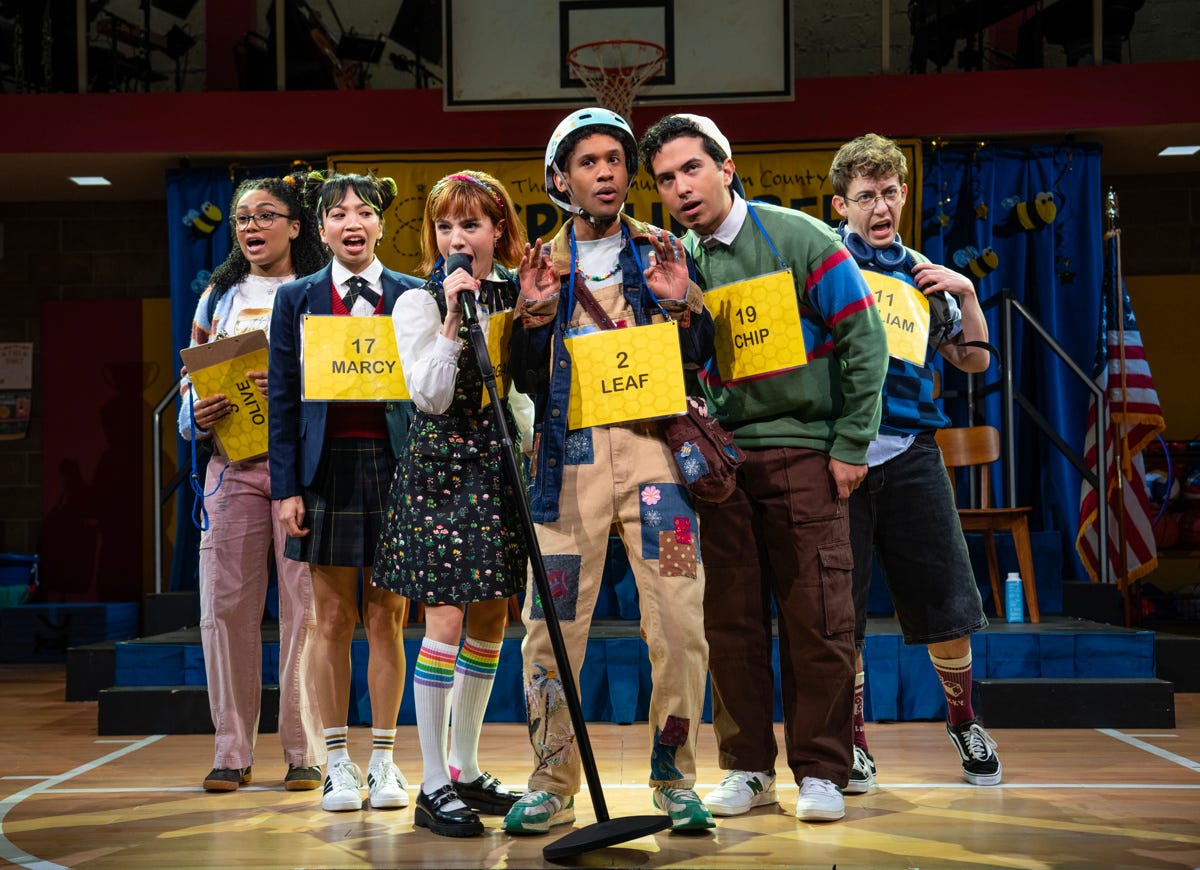
Here's a not-hot take: part of what makes theater magical is that each performance only happens once.
I've written about it (a lot) but I'd be lying if I said I always felt it.
Yet there are some shows, some pieces, that make that feeling almost inevitable. Unavoidable.
Enter The 25th Annual Putnam County Spelling Bee. A twenty-year-old musical that's been done in almost every high school in America. It would be sane to think that a show that's been produced that much would feel dusty or stale or just plain predictable.
But sitting in the audience in New World Stages, where the latest revival of Spelling Bee is currently running, I felt that good-good theater magic.
So what is it about this quirky little musical that triggered it? That's what I want to sit with this week—what happens to a room of strangers when a show makes its own unrepeatability impossible to ignore.
O-n-w-a-r-d.
The Beginning
This isn't my first Bee.
I had the cast album of Spelling Bee before I ever saw the show. I knew every word back and forth. I loved it the way you love a thing you've only heard. Completely, and from a distance.
Then the sit-down production came to the Drury Lane in downtown Chicago, and I finally saw it on its feet. I was thirteen. I had never experienced anything like it—I loved it instantly, helplessly, and I had no idea how to say why.
I bought a red ringer tee in the lobby and wore it for years, through high school and most of college. It is still one of the only pieces of show merch I have ever actually worn.
And the thing I wanted, more than almost anything? To be one of the three people pulled out of the audience to spell.
The Bystanders
The premise, if you've never seen it: Spelling Bee is a musical about a middle school spelling bee—and three of the spellers are real people, pulled from the audience. Not actors. Not plants. Three strangers who, a few minutes earlier, were looking for their seats. Bystanders turned spellers.
They go up onstage, they're given real words, and they have to spell them. For real. Nobody knows exactly what will happen—not you, not the three of them, not even the cast.
Yes—the company has its bits ready. But the raw material is new every night—they're improvising around three people who have never done this and never will again.
It would be easy to file that under "audience participation." But that misses what's unusual. Plenty of shows acknowledge they're live—an ad-lib about the weather, a performer naming the city.
In Spelling Bee: the unpredictability is baked into the foundation of the show. Take the three strangers out and it's not (really) Spelling Bee.
The Body
Your brain, more than anything, is a prediction machine—every moment guessing what comes next, spending its attention on how wrong each guess turns out to be. Neuroscientists call that gap prediction error. It's the currency of attention.
A locked show is a low-error environment. Not an insult—it can still wreck you. But it does what it was built to do, the way it was built to do it. Your brain, sensing no surprises, settles slightly. And the once-ness drifts back into the abstract. You know it. But you don't necessarily feel it.
The three strangers make settling impossible. They flood the room with real prediction error—three people whose next syllable or step can't be guessed by anyone, themselves included. Your brain fires. You lean forward. You have no choice.
That's the conversion. The once-ness was always true. The strangers are what make your body believe it.
The Break
Now I have to be honest, because there's an obvious objection and it's a good one.
The audience spellers are, mostly, a comedy bit—funny and loose and human, and then, fairly quickly, gone. The part of Spelling Bee that breaks you isn't them. For me, it's "The I Love You Song." Every single time. That's the thing that breaks me. And that song happens (and hits) in the same spot every night.
So if I told you the strangers are THE reason the show lands, I'd be overselling them. They aren't the heart. The heart was written and rehearsed and locked.
But they do something the scripted heart can't do for itself. They calibrate the room—they spend the first stretch teaching your nervous system that tonight is unsettled, genuinely unrepeatable. And once your body believes that, it doesn't stop believing it when the volunteers sit back down.
You carry that alertness into every moment after. By the time Olive sings, you're watching a locked, word-for-word number with the attention three amateurs installed in you an hour earlier. That's how a show that's ninety percent fixed can still feel, all the way through, like it's happening just once.
Because it is.
The Bee-ing
Spelling Bee is one of the most-produced musicals in America—running in high schools and community theaters probably within twenty miles of wherever you're reading this. By any measure, the opposite of rare.
And it's also one of the least repeatable things ever built for a stage. No two performances can be the same—not at New World Stages, not in any cafeteria in Ohio—because three of the people in every one have never done it before and (probably) never will again.
So the preciousness I felt was never about scarcity. It's something else: the instance can't be duplicated. This room. These three strangers. This night, this arrangement of people who will never be gathered again.
To be clear: that was always true. Of Spelling Bee, and of the longest-running show on Broadway grinding out on a Tuesday night. The once-ness was never Spelling Bee's invention. The show just built a room where I couldn't look away from it.
So I don't know what to do with the obvious next question—whether every show should reach for this. Maybe not. Maybe the feeling depends on being rare—maybe you only get a handful of nights, ever, where the wallpaper peels and you feel the thing you always technically knew.
Maybe that's the deal. You don't get to feel it all the time.
You just have to be there. Or, in this case, bee there.
This week in One Last Thing: what happened when I went to the Drama Desk Awards on Sunday—and why this whole piece felt different to write afterward.
It's for paid subscribers ($5/month), which helps keep The Fourth Wall alive and independent. Either way, I'm grateful you're here.
One last thing…
Sunday night, I officially became a Drama Desk Loser—a phrase I have gotten an unreasonable amount of joy out of saying this week.
But if I'm honest: it genuinely did not matter. What happened, for me, on Sunday had nothing to do with what was in that envelope.