


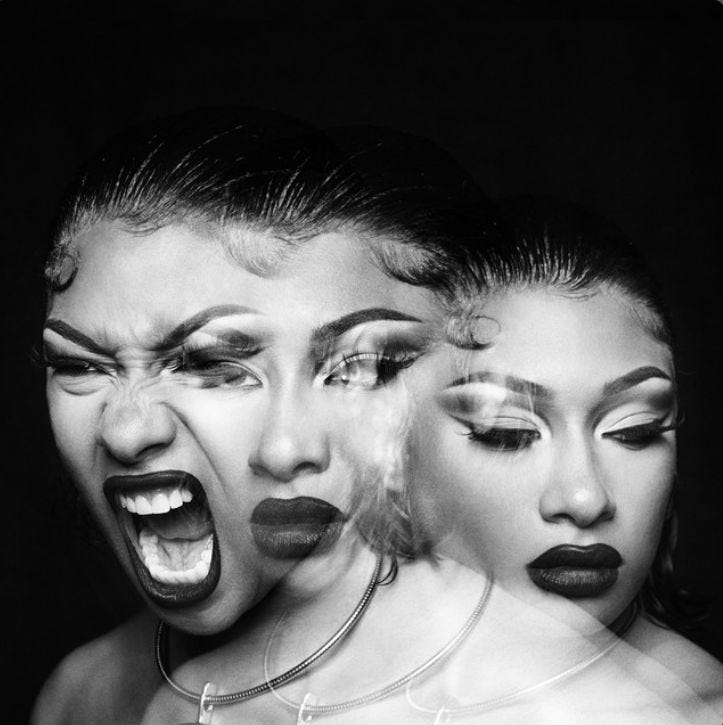
Megan Thee Stallion is leaving Moulin Rouge! two weeks early. She collapsed in her first week of the run—diagnosed with extreme exhaustion, dehydration, vasoconstriction, and low metabolic levels. Depending on which corner of the internet you’re on, there’s also a breakup.
We don’t know her whole truth. We may never. She hasn’t said much beyond I’ve been pushing myself past my limits, running on empty, and my body finally said enough. Speculation is pointless, so I won’t do it here.
But that sentiment—of pushing past limits and running on empty—is something every performer recognizes in their body-ody-odys.
Whether you slept last night, whether you ate this afternoon, whether the person you love just left, whether you got the call you were dreading on the way to half-hour—you’ve got a show to do. Eight times a week.
The conventional response to all of that is admiration. What stamina! What skill! What a talent! And those words aren’t wrong. But they’re also a kind of cover. They make the toll legible only as virtuosity. They turn the cost into a compliment.
The general public, I think, doesn’t quite believe how much working in theater asks of a body. They might intellectually concede it. But they don’t feel it. And the not-feeling is part of why the conditions of the work don’t change.
That’s what I want to sit with. The illusion. What it asks. What it costs. What we don’t talk about because we are so good, by training, by reflex, by contract, at making hard things look easy.
Shall we?
The 8x
A performer’s body is an instrument doing repetitive precision work for hours, eight times a week. That’s the most boring possible way to say it, and it’s the most useful, because it’s the part people most reliably forget.
Researchers at NYU have started measuring vocal output the way a Fitbit measures steps. They put dosimeters on Broadway-bound singers and watch the data come back—duration of phonation, pitch, intensity, the literal accumulated vibrations of folds against folds. It’s the most rigorous look anyone has taken at what a contemporary theater role actually demands.
And the data, so far, says…drumroll…we don’t know. We can measure the impact. But we cannot tell you where the line is. The researchers have been honest—the threshold of “how much is too much” hasn’t been defined, especially with little to no vocal rest in between eight shows a week.
That admission is more meaningful than it might sound. It means an entire profession is operating without a known threshold of safety. Performers go out there every night doing something that we cannot (in any objective sense) prove the body can sustain. And we’re collecting evidence in real time, on the bodies themselves.
The ultimate toll isn’t an injury. It’s the steady wear of a thousand small things. The big dance number every night for a year. The vocal placement that keeps you from blowing out at the top of act two but slowly tightens something in the back of your jaw. The understudy you don’t trust, so you go on with the cold. The stretch you did before the show that pulled something wrong.
The eight times. The eight times. The eight times.
By the time the body says enough, it’s already been saying it for a while. The call-out is just the part the public sees.
The Score
Here’s where the instrument metaphor breaks down. An instrument can be put away. A cello doesn’t have to keep being a cello between performances. A body does.
A performer’s body is also their emotional body. The same nervous system that has to belt the high note at 8:44pm is the nervous system that absorbed the news from the doctor’s office at 8:44am. The same diaphragm that supports the long phrase is the diaphragm that’s been clenched all afternoon because of that conversation you need to have. There is no offstage version of your body you get to leave in the dressing room. You bring it all.
And theater asks you to do something specific with that: to take whatever the day gave you and metabolize it into the work. Channel it somehow. Let it become the texture of what you’re doing on stage.
This is the part the audience most reliably underestimates because they don’t have to think about it. They paid for the show. They came to see the show. They have no obligation to wonder what the person on stage is carrying.
But the person is carrying something. And the body is the thing carrying it.
And even when the day was too heavy, or the loss was too fresh, or the body just doesn’t have it—you might still go on anyway. You go on, and you do the work as well as you can, and the audience probably never knows.
The clinical version of what this does over time isn’t surprising. Chronic anxiety. Perfectionism. Burnout. A body that stops finding rest restorative. A nervous system that lives, low-grade, in the ready position for so long it forgets what neutral feels like. The mental health research on performers is consistent enough that it’s almost boring to cite. The data confirms what the bodies were already saying.
The body keeps the score. Eventually, the body files the report.
The Reflex
The illusion is the product. The high note sounds inevitable. The choreography looks natural. The grief in the second-act ballad is fresh, even on a Sunday matinee, even when you did it last night, even when you’ve done it 312 times. Performers and directors and creative teams work in concert to make the labor disappear. The seam is the enemy. Hiding it is the job. For some.
For others, like the guys in Mexodus, the visibility of their process is part of the art. They wear the construction proudly. They refuse to hide the making—and it becomes a different kind of magic.
But what nobody mentions about the version that hides it is that the hiding doesn’t stay in the theater. You train yourself, over months and years, to hold your truth at a very specific distance. Far enough away that it doesn’t get in the way of the work. Close enough that it can inform and inspire and ignite something unique every night. That’s the calibration. That’s the craft. And it works—until the calibration becomes a reflex, and the reflex becomes a habit, and the habit follows you home.
The self-concealment that protects the performance starts to govern everything else. The internal barometer that tells you this is too much, this is not okay, I am not okay—it gets drowned out. Not because you’re broken. Because you got very, very good at not letting it interfere with the task at hand.
You lose touch with your own signal. The instrument that was supposed to feel everything has learned, through repetition, to keep feeling things at a precise and managed distance.
That’s the cost the audience never sees. Not just the physical toll. The quiet erosion of the thing underneath the performance—the sense of self that was supposed to be the source of all of it.
The Acknowledgment
I don’t have a fix. I want to say that out loud because I think the absence of a fix is part of why this conversation rarely happens. The economics of Broadway require eight shows a week to break even. Every honest version of the conversation about reducing the schedule ends in the same place: who pays for it. The producers can’t, the unions know it, the audience doesn’t want ticket prices any higher than they already are. The math doesn’t math.
So this isn’t a piece arguing for a six-show week. It’s not even a piece arguing for anything in particular. It’s me trying, mostly, to say a thing out loud.
The precondition for anything ever changing is that the audience—the public, the press, the casual fan, the producer, the politician—actually believes that the work is hard. Not as a compliment. As a fact.
I’m aware that you, reading this, may already know all of this. Many of you live it. I’m not telling you anything you haven’t been carrying yourself.
But maybe a few people who don’t live it will read this, and the next time they see a performer make an impossibly hard thing look easy, they’ll let themselves register that the easy is the achievement, and the hard is the truth.
That’s all this is. Not a solution or a demand or a manifesto. Just a small, stubborn refusal to call the cost a compliment.
For paid subscribers this week: a memory from deep in the BEAU run that got me thinking about bodies, hiding and all that sappy jazz. ($5/month, which helps keep The Fourth Wall alive and independent. Either way, thank you for being here.)
One last thing…
There’s a scene towards the end of (10-time-Drama-Desk-nominated) BEAU that I’d been doing a version of for close to a decade. It involves tears and heaves and hugs and one night in December, between sobs, a thought arrived.