


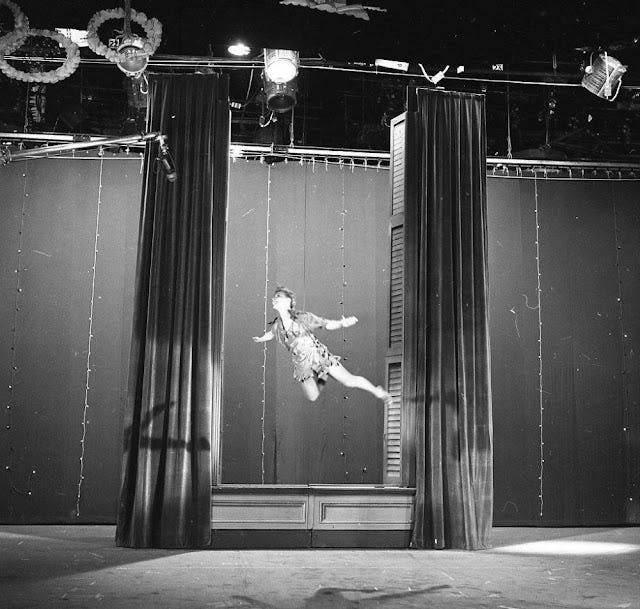
On December 8, 1960, NBC taped Mary Martin playing Peter Pan.
Thirty-six years later, that tape was on loop in our suburban Chicago living room. I was four.
I have no memory of learning that musicals existed. By the time I could form memories I was already deep in that VHS, rewinding it, wearing it out, wholly obsessed in the complete and humorless way only a little boy could be.
Last Friday, a "pro-shot" of Hadestown opened in 1,949 movie theaters across North America. It was booked for five days. It made $10.2 million in its opening weekend, passed Hamilton's theatrical record, became the highest-grossing live capture ever made, and the five-day run turned into an indefinite one.
And the common questions resurfaced. Whether a camera can translate what a theater holds. Whether this counts as access or as a consolation prize. Whether anyone who watches it on a screen will ever buy a ticket to the real thing.
That's what I want to get into this week—the specific job these pro-shots do, and why they stand on their own next to the cast album and velvet seats.
All aboard.
The Loop
Speaking from experience, a five-year-old does not watch a musical once.
A five-year-old watches it forty times. Rewinds the same ninety seconds until the tracking lines go fuzzy. Learns the words, then the breaths between the words, then the exact half-second before a cue. That repetition is how a kid falls in love with anything, and it's how they eventually work out that a person made all of it on purpose.
You cannot do that with a live show.
Even with money, even in the right city, even if the tickets were somehow free—it plays once a night, and then it's gone, and eventually it's gone for good. Live is a one-time offer, every single time.
Earlier this year I watched Next to Normal three times on YouTube. Three times, in six weeks. I can't tell you the last time I saw the same musical three times in six weeks, because I haven't. It felt like a gift.
Sixty-six years of technology sits between that VHS and that YouTube tab, and the behavior is identical.
Passing Strange closed on Broadway on July 20, 2008, after 165 performances. Spike Lee filmed it on July 19. The run is eighteen years gone and the movie is still right there.
So before a pro-shot does anything else, it makes a show available more than once, and in more than one town. Nineteen hundred and forty-nine movie theaters at once, in places that were never getting a tour, on a Thursday afternoon, for the price of a ticket.
Hadestown has been at the Walter Kerr since 2019, eight shows a week, running about 98 percent full. That comes to roughly 380,000 people a year. The film did that number in three days.
Cast recordings, one could argue, are close cousins—but there's something these pro-shots have that the albums don't.
What You Can't Hear
The original cast recording of Peter Pan has "I'm Flying" on it.
If that's all you have, you hear Mary Martin singing about flying. You believe her completely, and your brain builds the rest—the window, the nursery, whatever a kid decides Neverland looks like. I wrote a whole piece in January about what that act of building does to us, so I'll leave it there.
Watching is a different event.
Watching, she leaves the ground. You can see the harness if you look for it. You can nearly see the wires. Behind her is a painted set, and past that, sometimes, an audience you can hear reacting in real time. Almost nothing is left to the imagination, and that turns out to be the gift. A kid doesn't have to picture any of it, because it's all right there being done. By a person.
An album can't hand you that, and a live show can't either, because a live show asks you to already be in the building.
An album tells you what a show sounds like. A capture tells you that it's a place, that people go there, and that you could be one of those people.
The Math
So the obvious next sentence is that we need more pro-shots. I'm not going to write it.
Hamilton's Broadway production was capitalized at $12.5 million. Filming it reportedly cost another ten to twelve. Nine cameras, two live performances in June of 2016, in front of people who had bought tickets. Disney then paid $75 million for the worldwide rights, reportedly the largest film acquisition anybody had ever made.
That's the version where everything goes right.
There is no standard contract for releasing a filmed Broadway show on demand. Every capture gets negotiated from scratch. Actors' Equity for the cast. The Stage Directors and Choreographers Society for the director. United Scenic Artists for the designers. Then the composers, the crew, and whoever controls the underlying rights, each one settling what a person is owed for a use their contract was never written to cover. Theater's labor structure was built for live work. Nobody has gotten around to writing the other one.
Then there's the arithmetic underneath all of it. Hamilton was an outlier. Filming a musical usually runs somewhere between one and a half and four million dollars. About one in five Broadway musicals earns back what it cost to open in the first place, so the ask is that a business failing four times out of five spend it anyway. And if the film rights have already been sold, the capture is off the table entirely. A producer picks one, and the film sale is usually the bigger check.
Even with the money and every signature, the math only closes for titles people have already heard of. Film everything, and most of it sits there unwatched.
So we get the captures we get. What happens after one of them lands is a different question.
The Sign-Up Sheet
Almost nobody I know got here by walking into a theater first.
Ask around. The theater people in your life were recruited by a screen or a pair of headphones. A tape. A PBS broadcast. A cast album from the library. Stepping inside a theater came later.
I'm one of them. I'm here, in part, because NBC rolled tape in 1960.
None of these forms could ever replace actually being there. It happens once. Things go wrong. An actor makes a choice on a Tuesday they will never make again, and the people in that house are the only ones who will ever know it happened.
The thing that actually moved me was much smaller than $10.2 million.
My parents watched me wear out that tape and did the obvious thing: they took me to a musical I could actually get to. Joseph and the Amazing Technicolor Dreamcoat, at the local high school. That's where the second obsession started. And then they signed me up for KIDSTAGE, the children's theater company in town.
A woman flying on a screen in my living room. A high school auditorium. A sign-up sheet.
The tape did its half. My parents did the other half. They noticed what a four-year-old was doing in front of a television, and they went and found him the nearest stage.
When Hadestown eventually hits streaming, there's some kid, somewhere, who will probably watch it more times than I watched Peter Pan.
That is how a screen becomes a door.
This week in One Last Thing: the musical movie I'm in that almost nobody has seen—and what it's been like to sit with that while writing a love letter to captures.
It's for paid subscribers ($5/month), which keeps The Fourth Wall independent and alive. Either way, I'm grateful you're here.