


When I was a teenager and into my early twenties, I spent my summers at an all-boys overnight camp in northern Wisconsin with limited access to technology. No cellphones. No video iPods. No TVs in the cabins.
But the Culver's in town? They had a few TVs.
That's where I'd go on Tony Sunday. I'd sit at a corner table by myself and stare at the tiny screen with the sound off. With cheese curds. Obviously.
I couldn't hear the speeches. I didn't always know who was who. I'd nurse a custard and squint at the silent screen and try to read lips. Try to imagine what the performances sounded like.
And I felt part of something.
Even from that table, the broadcast worked on me. What was actually on the screen barely mattered. What mattered was the knowledge that in other places—other corners, other couches—my people were watching too.
Here's the thing I understand now that I didn't then: that wasn't really knowledge. I had no proof. I'd never met most of those people. I couldn’t see them. I just believed they were out there.
Which, it turns out, is most of what loving theater is.
Especially if you don't live in New York, or Chicago, or one of the handful of cities where the thing you love has a physical address. You love it from a distance. You give three months of your life to a show that closes in a weekend. You weep at eight bars of music on a cast recording, and you trust—without evidence—that somewhere out there are people who weep at the same eight bars. You can't see them. You take them on faith.
Loving theater is an act of faith.
The Form
Faith needs rooms.
Live theater runs on a mechanism most of the rest of culture has stopped requiring. People in the same place at the same time, paying attention to the same thing, knowing they're in it together.
When a show works, the room does as much of the work as the stage. The audience gets its nervous systems entrained to a single point. Laughter cascades because other people are laughing. You hold your breath because everyone else is holding theirs. The cry at the end gets louder because the person next to you is crying too. (Sometimes sobbing, actually.)
I've written at length about collective effervescence—what happens when a group's attention locks onto one thing, together, until the individual experience fades away and a sense of belonging or Loving Awareness emerges. Émile Durkheim, who coined the term, didn't find it on a stage. He found it in religion. In ritual. In congregations facing the same direction, saying the same words, until something larger than any single person in the room seemed to fill it.
Which is the quiet thing theater has always been. A roomful of strangers, facing the same direction, agreeing to believe the same impossible thing for two hours. Take the room away and theater stops being theater. The faith has nowhere to land.
The Country
Most other consumption runs on the opposite premise. The internet is built for asynchrony—watch what you want, when you want, alone if you want. Theater insists on the older bargain: we are all right here, right now.
The catch is you have to be there. And most of us, most of the time, aren't. We love this thing from our own shores, catching glimpses of each other's lighthouses, never quite able to see the others sailing out there. We're not unique in this. Every fandom, every devotion, is reaching for the same thing—some way to feel less alone in what it loves. We just happen to love the one art form that is built on being in a room together, and then spend most of our time apart.
Except one Sunday in June.
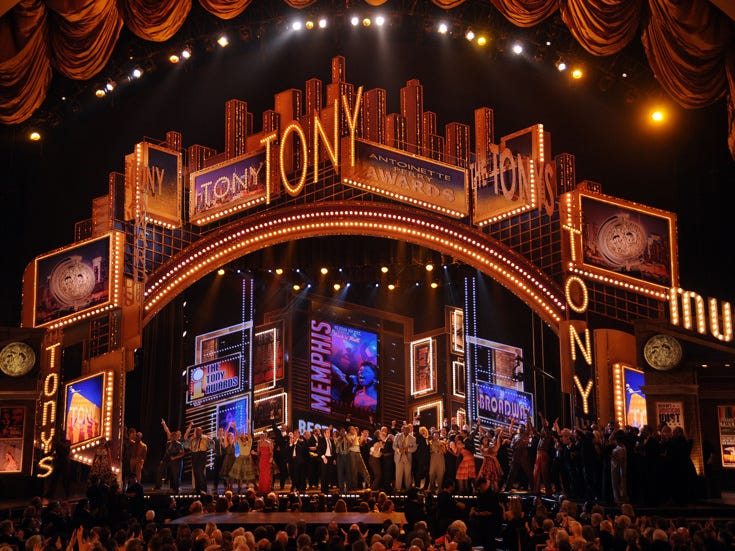
I was a post-producer for the 2022 Tony Awards, and I can tell you Radio City runs on the exact same mechanism as any black box with forty folding chairs. Same entrainment. Same held breath. The only difference is what's around it.
The performers know they're being watched by millions of other rooms. The audience in the seats knows their experience is being shared, in real time, by every theater person who tuned in. And the reverse holds: from the apartments and the watch parties and the dorm rooms and the silent TVs, you know there's a room full of your people at Radio City. You're watching what your high school theater teacher is watching. What the casting director who passed on you last week is watching. What your Mom (or at least my Mom) is watching.
For three hours, the room that normally fits in a building grows to the size of the country. The faith gets its room.
The winners and gowns and cameras and tuxes are decorations. The thing underneath—the reason it makes a kid at a Culver's cry—is that for one night, the whole scattered congregation is in one place, facing the same direction.
The Church
Here's the problem: that Church of Radio City doesn't have enough pews for everyone.
So this year, we built some.
It's called Antoinette—an unofficial Tony pool on theater.games. You pick the winners. You do it with your people: a pool you start, or one you join. Next Sunday when the big show starts, the picks lock, and as each envelope opens you watch your guesses come true or not—together, in real time. If you've ever filled out a March Madness bracket (which I have not), you know the shape of it. Except the categories are Best Lighting Design in a Play and Best Original Score. And the people you're up against cry at key changes. (My people!!)
And somewhere out there, a stranger you'll never meet is doing the exact same thing with other people you'll never meet. You can't see them. But you know they're there. Picking too.
It is, I'll admit, a strange little act of faith. A scorecard is not a sacrament. But it does the one thing the silent TV never could: it gives the night a shape you can hold in your hand. A reason to gather. A direction to face. The same sacred texts—Best Whatever in a Whatever by a Whatever—read aloud at the same hour, in living rooms that will never know what's hanging on each other's walls.
The pool was never about being right. It's about not being alone in front of the screen.
One Sunday in June
The kid at the corner table took the whole thing on faith. He believed his people were out there, squinting at their own screens, even though he couldn't actually see a single one of them.
Once a year, he's proven right.
So pull up a chair. Start a pool, or join one. Fill in your picks. Get them gloriously wrong. It doesn't matter, really. But it does mean that next Sunday, when the Church doors open and the room becomes the country, you'll have a seat in it.
The faithful have always needed somewhere to gather. Next Sunday, mine's a silly little scorecard.
There's a chair next to me, if you want it.
This week in One Last Thing: Where my faith that "my people are out there" actually came from. Turns out it wasn't theater.
It’s for paid subscribers ($5/month), which keeps The Fourth Wall independent and alive. Either way, I'm truly grateful you're here.
