


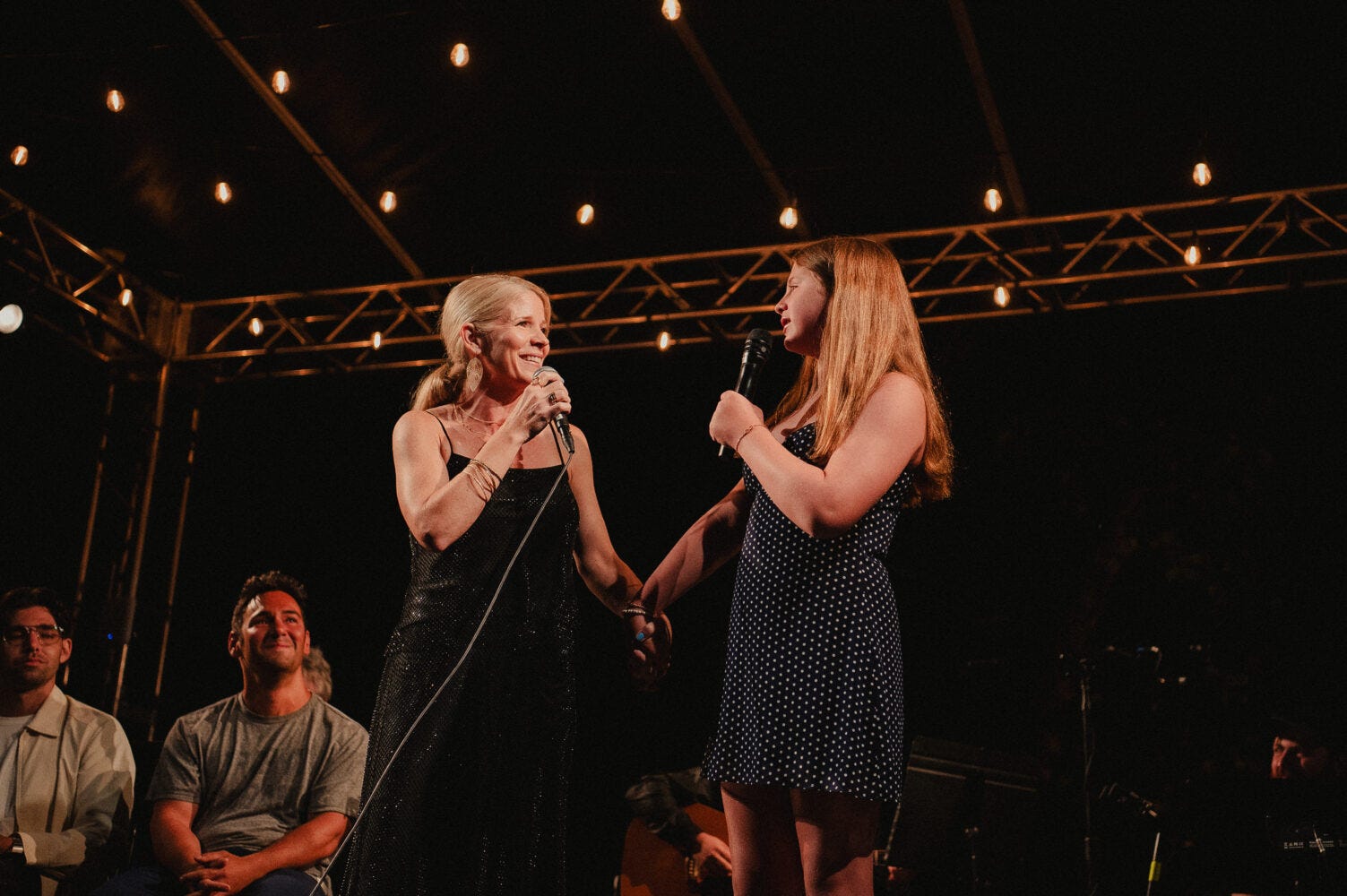
Saturday night, in a field in Kingston, New York, I hosted a campfire. Which is how I ended up sitting four feet behind Kelli O'Hara while she sang "Both Sides Now" with her daughter.
That campfire also had Adam Pascal doing an acoustic "Memory," and Jenn Colella, and Lauren Patten, and Norbert Leo Butz. It was the second night of The Festival—three days of Broadway in a reclaimed brickyard on the Hudson.
Earlier that same day, thirteen of the fifteen original Broadway cast members of RENT closed their set with "Seasons of Love."
This Festival was filled with moments like this. Out-of-body. Tangibly ephemeral. You could feel the precious seconds slipping by. Wholly present and then suddenly emotional that the present had passed.
I've come to call these moments in the woods.
That sensation, the awareness of the magic of a moment, and then having to process what it means, that's what I want to sit with this week. How we reconcile the sweetness and the sorrow of an experience being once-in-a-lifetime. And what remains.
Into the woods it's time go.
I keep getting asked, "how was it?" Which, I've found, is nearly impossible to answer.
There's no clean way to describe watching Chris Jackson sing "One Last Time," and Audra McDonald sing "Stars and the Moon," and Brian Stokes Mitchell sing "The Impossible Dream," and then walking onto that same stage, in front of more than 2,500 people, and singing "Getting Married Today."
Or what it was like to see my name printed alongside people I have looked up to my entire life. People who are, in a real way, part of the story of how I got here.
So as a fan, and as a performer, what was this weekend like? Honestly?
It was hard to hold.
Researchers who study awe have watched this hard-to-holdness happen on brain scans: the default mode network—the system that runs your self-narration, the constant commentary about how you're doing, how you're coming across, what's next—goes quiet.
People in a state of awe report their sense of self gets smaller. They merge with the moment. The internal machinery slows down, and what's left is whatever is happening directly in front of you.
It’s a close cousin of collective effervescence, with an extra splash of wonder on top.
Your mind may try to calculate, in real time, the convergence of circumstances that lined up to create this moment, but it all falls away. You are just there. Completely, unrecoverably present.
That's why I can't describe this weekend simply. The part of my brain that would normally be taking notes was completely offline.
On Monday, when I got on a plane to fly home to LA, I was carrying immense gratitude for what had transpired and deep grief that it was over. Whole body elation, and overwhelming sadness. I spent the flight trying to make it all make sense. Trying to reconcile the bothness. And frankly, I struggled.
For a long time I concluded that this was a personal defect—some inability to be normal about good thing. Incapable of just saying thank you and moving along with my life like a well-adjusted adult.
But science has an answer for this as well.
Awe, by definition, requires an experience to NOT fit neatly into our existing frameworks. If our minds are able to sort a moment into a pre-existing slot, then we can't and won’t experience that all-consuming sense of wonder.
The struggle to make sense of something like this is evidence that it was, indeed, profound. No wonder!
So when we arrive at Moments in the Woods in Act II of Into The Woods, we get to witness this happening in real time for The Baker's Wife.
She's just had an encounter with Cinderella's Prince. He charmed her, kissed her, and then disappears into the trees. She's left alone, in the middle of the woods, having just had a profound experience that she now needs to reconcile.
We watch her processing. She can't quite believe it. She plays it back. She wants more of it (and says so.) She does the math on her actual life—the husband, the baby, the bakery—against this thing that just happened amongst the trees.
And what she arrives at, in about three minutes, is that she cannot have both.
The moment was real, and the moment is over. And because she can't have that moment all the time, her life is richer. She understands that the "or" makes both the moment and her real life more meaningful.
In my opinion, it's Sondheim at his best. Taking something that is nearly indescribable and packaging it, neatly, inside a rhyme.
And now, no surprise, it's become part of my personal dictionary of feelings.
A festival is hardly the only kind of moment in the woods.
A birth. A death. A wedding, a breakup, a disaster, a miracle. The architecture is the same every time. Circumstances converge, and you're consumed by what's happening. Then it's over, and you're somewhere ordinary—a kitchen, a parking lot, an airplane seat—holding something enormous.
You're forced to create a new space in your head or heart that can carry this new experience. Your internal framework has to change. You are fundamentally different than who you were before.
That's what happened, for me, at The Festival.
It was a moment in the woods.
It was beautiful and profound and heart-opening, and then it was over. I left feeling inspired and proud and sad and depleted and totally lost and completely found.
On Sunday I was in the woods, crying from Audra's performance of "Some People," and then on Monday I was picking up my dog's poop off the sidewalk.
As The Baker’s Wife says:
Let the moment go
Don't forget it for a moment, though
Just remembering you've had an "and"
When you're back to "or"
Makes the "or" mean more
Than it did before
Now I understand
And it’s time to leave the woods
This week in One last thing: the first moment in the woods I ever had, what I did with it, and how long it took me to truly understand it.
It's for paid subscribers ($5/month), which keeps The Fourth Wall independent and alive. Either way, I'm grateful you're here.
I needed this. Having just experienced my own "moment in the woods" at Ragtime closing on Sunday. You perfectly articulated what I have been feeling all week. Thank you so so much.
Gorgeous writing, gorgeous feelings. Thank you for taking us with you.