


The first week after the Tonys, the buzz held.
Winners trending, speeches recirculating, everyone still posting their dresses and their gratitude. A whole industry riding the high.
Then, sometime this week, it started to wear off.
Reality slowly returns. The eight-show week. The Wednesday matinee. The grosses report. The quiet, constant math of what will stay open and what might close, who's selling and who isn't, whether the thing you poured your year into will still be running come fall.
This happens every June. The season crescendos on one Sunday night, the whole industry exhales at once, and we slide into the strangeness of summer. We tend to treat that slide like weather—something to push through, white-knuckle, outlast.
And I think we might have it backwards.
We treat the coming-down like dead air, the empty stretch between the parts that matter. I've started to suspect it's one of the most important things we do—and one of the only things nobody ever taught us how to do well.
Let's get into it.
The Loans
A high is expensive. We just tend to put it on credit.
Dopamine is commonly understood as the feel-good hit—the chemical of the win. It isn't, really. Dopamine is the chemical of the chase: the lean-forward, the almost, the wanting. It spikes on the way toward the thing, not at it. It's the fuel of the climb.
So a long build runs you hot for months. Opening night on the horizon. The review that might land. The nomination you might get. Every day there's a next rung, and your brain doses it. You get used to operating at that altitude. It starts to feel like your normal.
Then you summit. The envelope opens, the run ends, the thing you were working toward is finally, simply, past—and the wanting has nothing left to want. The dopamine drip runs dry. And because you'd recalibrated to running high, the new baseline reads as a deficit. As gray. As is that it? As now what?
Then the other shoe. To do hard things on a schedule—eight shows a week, a body that performs whether or not it slept, whether or not it's sad—you run on stress hormones. Adrenaline and cortisol are what let you rise to the occasion. They're also a loan. They sharpen you now by borrowing against later: holding back the exhaustion, muting the cold you should have caught, postponing the feelings that never had the time to process.
The day the push ends, the loan comes due. All at once. It's why people get sick on the first morning of vacation. It's why Olympic athletes report higher rates of depression after winning medals. Why the cry finally arrives. The body senses it's safe, stops holding the line, and everything it was holding back walks through the door.
That flat, gray, tearful Tuesday is a receipt—the bill for having cared that much, paid in the currency you'd been quietly borrowing all along.
The Loops
Our whole industry is a comedown machine.
We don't get one peak. They're on a loop. A show opens and closes. A contract starts and ends. A season builds for months, crests on a single Sunday, and then—dark. We pour everything into things that are designed, from the first day of rehearsal, to end. Coming down is literally half the job. We're just not very good at it.
Think about how an athlete treats the off-season. It's part of the sport. It's where the body repairs. It's where the foundation for the next season gets built. Nobody tells a marathoner the recovery weeks are dead time. Recovery is the discipline. It gets coached, scheduled, respected.
Artists, typically, don't have that. We have a summer we're supposed to fight through to keep the lights on—which is real, and a livelihood, and I'm not waving it away. But the lulls show up in all shapes and sizes. The long stretch between jobs. The deafening silence after a project you loved ends. The plain, physical downslope of a wave that went up and now, inevitably, has to come back down.
And our instinct, every single time, is to fight it. Fill it. Fix it. Book the next thing fast enough that we never have to feel the floor.
But the comedown isn't a problem to be solved. It's a real, true, heavy loss.
Grace
If the comedown is a small grief, then we already know exactly what it needs.
We don't tell a grieving friend to hustle through it. We don't ask them why they aren't more grateful for the good times. We don't hand them a five-year plan on day three. We make them tea (or bowls of ice cream). We sit with them. We let it take the time it takes, and we treat the sadness as evidence that something mattered.
The comedown deserves that same grace.
It's letting the trough run as long as the crest was high. It's resisting the urge to stuff every quiet week with proof that you're still going.
I don't have a method for this. I'm suspicious of anyone selling one. But there's a better question than how do I get out of this faster. It's the one we ask the people we love, turned inward for once: what do you need, right now?
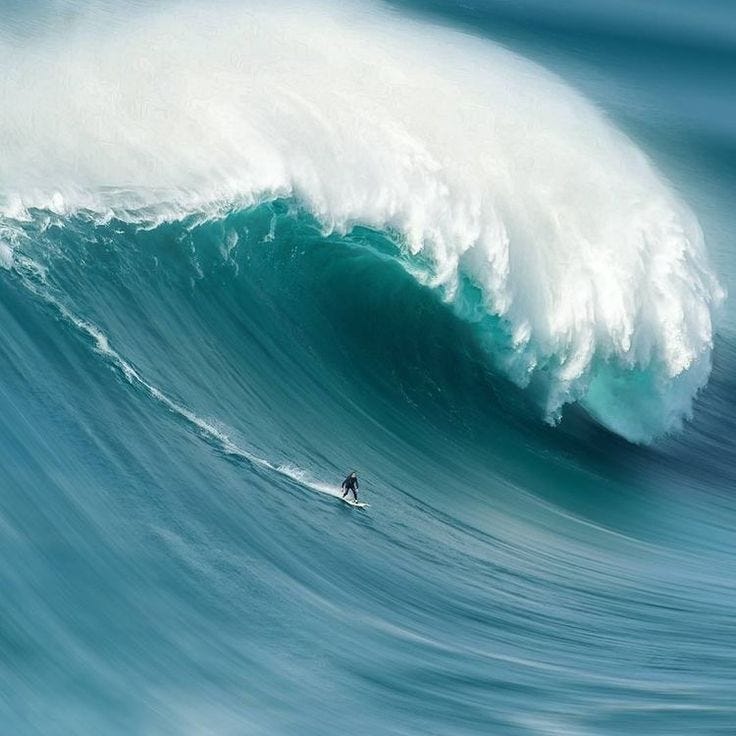
The wave is going to do what waves do. Rise and then fall. The only part we get to choose is how we ride it.
With some practice, I think we're more than capable of taking a cue from nature. Letting the wave carry us, arms open, shoulders relaxed, breathing deep and giving over to all of it.
Every last gray, gorgeous, extraordinary, ordinary minute of it.
Surfs up.
This week in One Last Thing: the comedown I didn't see coming after two months in LA.
It's for paid subscribers ($5/month), which keeps The Fourth Wall independent and alive. Either way, I'm grateful you're here.