


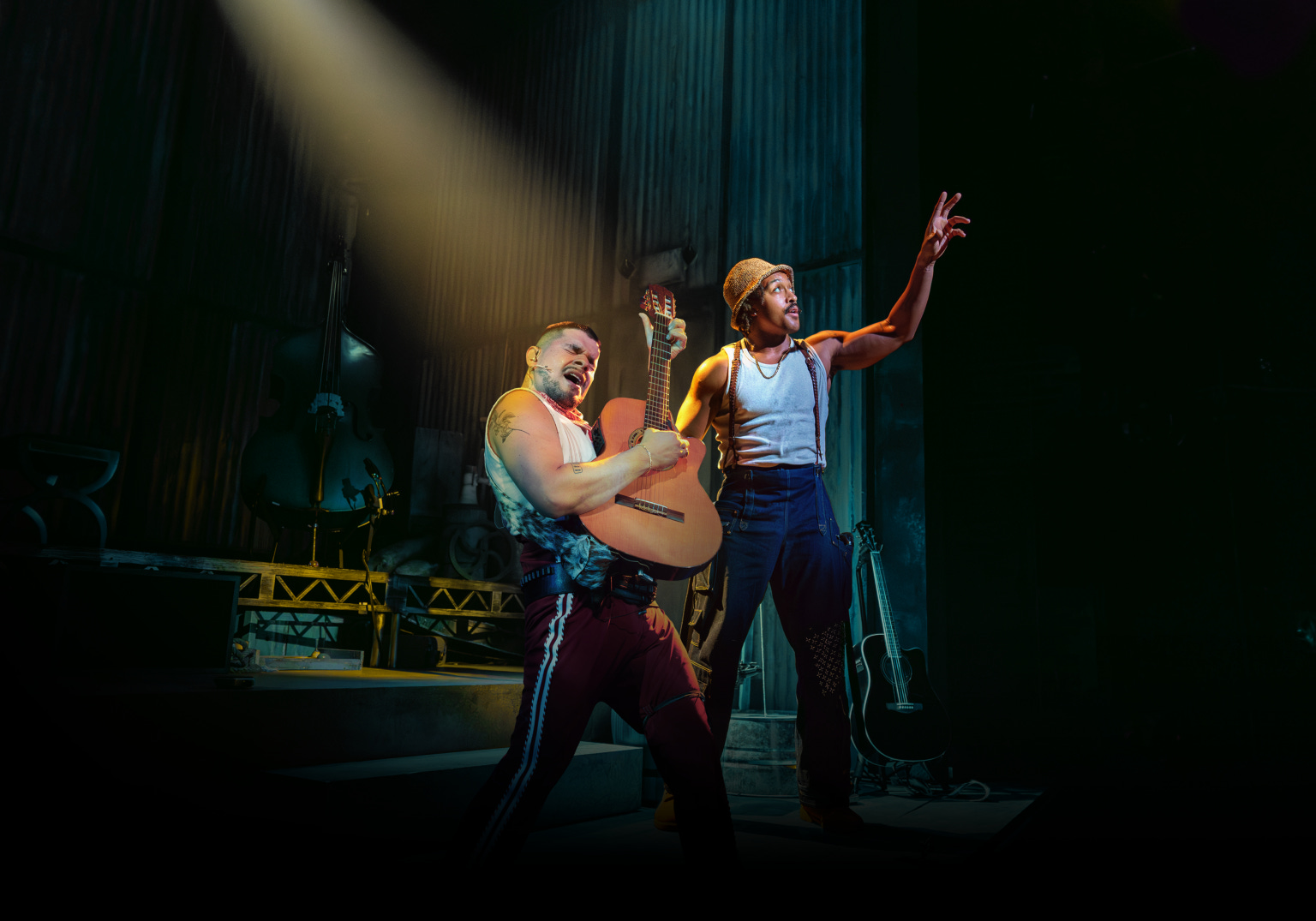
I have a bad habit of over-explaining what I think a show is going to be before I see it.
A year of hearing about Mexodus—from my friends who were producing it, in hallway conversations, in the slow accumulation of buzz that happens when a piece keeps getting extended—meant that by the time I sat down in the Daryl Roth a few weeks ago, I had already written the show in my head. I knew it was two-person. I knew about the live looping. I knew it had something to do with the Underground Railroad running south, into Mexico. I knew it had won Helen Hayes Awards. I knew Lin-Manuel Miranda had said something about it online.
I thought I knew what I was walking into.
And then they knocked on the door.
The Knock
Brian Quijada and Nygel D. Robinson don't begin Mexodus by finding themselves already in a scene. They knock. They come in. And then they explain, directly to us, who they are and why they're here.
It's a disarmingly simple gesture. And it changes everything about what follows.
When a show breaks the fourth wall—when a performer turns and addresses the audience—we usually understand it as a technique. A stylistic choice. The actor briefly steps out of the fiction to acknowledge the room, and then steps back in. It's a wink. A rupture.
What Brian and Nygel do is different. They don't break the fourth wall. They never build it in the first place.
They walk in as themselves—two multi-instrumentalists, a Black man and a Brown man, who found a story they couldn't believe wasn't in any textbook—and they tell us that. Out loud. At the top of the show. Before anyone has been asked to believe anything, they account for their own presence. They say: here's who we are, here's what we found, here's what we're going to do.
The opening call-and-response goes something like this: Did you know this shit? We didn't know this shit. And then: Why? Cuz it wasn't allowed, it wasn't allowed…it wasn't spoken aloud. It's funny and raw and immediate. And in about thirty seconds it puts the audience and the performers on exactly the same footing—equally astonished, equally implicated, equally in on it.
What I felt when that happened—and I've been trying to find the right word for it—was relief.
Theater asks a lot of us. It asks us to believe. To suspend. To accept the terms. Usually those terms aren't stated—we're expected to understand them from context, to slip into the fiction and not ask questions. And most of the time, we do. But there's always a low-grade labor in that. A kind of vigilance.
The moment Brian and Nygel knocked on that door, the vigilance released. Because they were saying, in the clearest possible terms: we see you. We know you're here. We know what this is. We're all in this together.
That's not a technique. That's a consent agreement.
The Veil
When Brian or Nygel picks up an instrument and plays a phrase into the loop pedal, they're not just making music. They're making the process of making music visible. The loop cycles. Another phrase gets laid on top. Then another. The song builds in real time, in front of you, from nothing. You watch it become itself.
In conventional musical theater, this is the opposite of how it works. You hear the finished thing. The orchestra is in a pit, or the tracks are pre-recorded, or at the very least the entire arrangement has been set and rehearsed until every element is invisible. The magic depends on concealment. You can't know how the sausage gets made because the sausage—as far as you're concerned—appears already made.
Mexodus shows you every step.
And what I kept waiting for—the moment where that transparency would break the spell, would make the whole thing feel less rather than more—never came.
Instead, the more I could see the mechanics, the more I trusted the magic. Because the magic wasn't the finished product. The magic was the act of making it. Right there, in the room, with their hands and their voices and their instruments.
This is a genuine argument about what theater can be. Not a gimmick. Not a format innovation. A philosophical claim: that the veil isn't required. That you don't have to hide how something is made for it to move people. That maybe the making is the thing that might move people most.
Director David Mendizábal put it precisely: "Looping was a metaphor for the labor that both characters were doing. The act of looping and creating music together was a metaphor for these two men working together, building trust, building solidarity." The form isn't separate from the story. It is the story. Every loop Brian lays down, every phrase Nygel records and builds on—it's Henry and Carlos, learning to trust each other across a border, piece by piece.
South
The story Brian and Nygel tell is one that most of us—including me—were never taught.
Between five and ten thousand enslaved people escaped bondage not by going north, but by going south. Across Texas. Across the Rio Grande. Into Mexico, where in 1829, Vicente Guerrero—who was himself of African descent—had abolished slavery. Thirty-four years before Lincoln. Mexico refused to sign a fugitive slave treaty with the United States. The law was simple: any enslaved person who set foot on Mexican soil was legally free.
This is the Underground Railroad that Mexodus is about.
The show they built around it is extraordinary in the way it holds two narratives at once. There's the story of Henry, an escaped enslaved man, and Carlos, a Mexican war veteran and farmer—a Black man and a Brown man finding each other across a border and saving each other's lives. And then there's the story of Brian and Nygel: two guys who found this history and couldn't let it go, who used every skill and instrument and tool they had to make sure you heard it too.
The show never lets you forget that both stories are happening. The history and the telling of it are equally present. And that doubleness is part of what makes Mexodus unlike anything I've seen on a stage.
The Impossible
At one point, Nygel says: I don't think I'm their wildest dreams. Because where we're from, you don't get to dream like this.
Take a second with that.
The wildest dream is still a dream—still tethered to what's imaginable, what the mind can reach for from inside a particular life. What Nygel is describing is something past that. A life that couldn't have been dreamed. A stage, a story, a loop pedal, sold-out houses, Lortel nominations—none of it inside the frame of what was possible to hope for. And what he's saying—as himself, as a Black man on a stage in New York City, telling a story about the Underground Railroad through instruments he plays with his own hands—is that he’s in a space his ancestors couldn't have imagined.
It's one of the most precise articulations of intergenerational possibility I've ever heard.
And it's also, somehow, a description of the show itself.
The Argument
Theater is a conservative art form in a lot of ways—attached to its conventions, its hierarchies, its traditions. The proscenium arch isn't going anywhere. Orchestras in pits aren't going anywhere. The implicit agreement to maintain the fiction, to not look at the lights, to not acknowledge that there's a human being two rows in front of you staring at the same stage—that's not going anywhere.
But Mexodus makes an argument that I think will be hard to ignore for anyone who experiences it. Not that all shows need to be like this—they shouldn't. That concealment isn't a prerequisite for transcendence. That a show can tell you exactly what it is, every step of the way, and still take you somewhere you've never been.
The veil, it turns out, was optional.
What Brian and Nygel have built is a piece of theater that trusts its audience completely. Trusts them to hold complexity. Trusts them to be moved by what's real. Trusts them to find the magic not in the illusion but in the witnessing.
That trust is rare. And when you feel it—sitting in a room where two people knocked on a door and told you exactly what they were going to do, and then did something so much bigger than they promised—it feels a little like what Nygel was describing.
It feels impossible. Made possible.
This week in One Last Thing: what it means to watch a show about crossing a border when you’ve just crossed one yourself.
It’s for paid subscribers ($5/month), which helps keep The Fourth Wall alive and independent. Either way, I’m grateful you’re here.
One last thing…
We (my husband and I) just moved to Los Angeles.
I’ve been sitting with that, trying to figure out what it means. Not logistically—logistically it means boxes and forwarding addresses and learning which freeways to avoid. I mean what it means about who I am now. What you leave behind when you leave a place. What you carry.