


Today I turn thirty-four. One week ago, I left New York.
I moved to the city at twenty-two. A one-way train from Boston. I landed at 53rd and 2nd—my first apartment, my first intersection, the first point on a map I didn’t know I was drawing.
Twelve years. That’s the distance between twenty-two and thirty-four. That’s also, it turns out, the distance between arriving somewhere and realizing it became part of you.
Sam and I are moving to Los Angeles. The reason is simple: Sam needs to be there for work. I’m his husband. We’re in this together. I want to say that plainly, because I think there’s a temptation to turn the move into something grander than it is. A reinvention. A statement. It’s not. It’s a marriage. It’s someone I love needing to be somewhere, and me going with him.
But the leaving part. The leaving part is something else entirely. Because it turns out that twelve years in a city doesn't just pass through you. It gets in.
This week, I wanted to understand why.
As I traipsed around the city over the past few weeks, knowing that we were on our way out, something strange started happening.
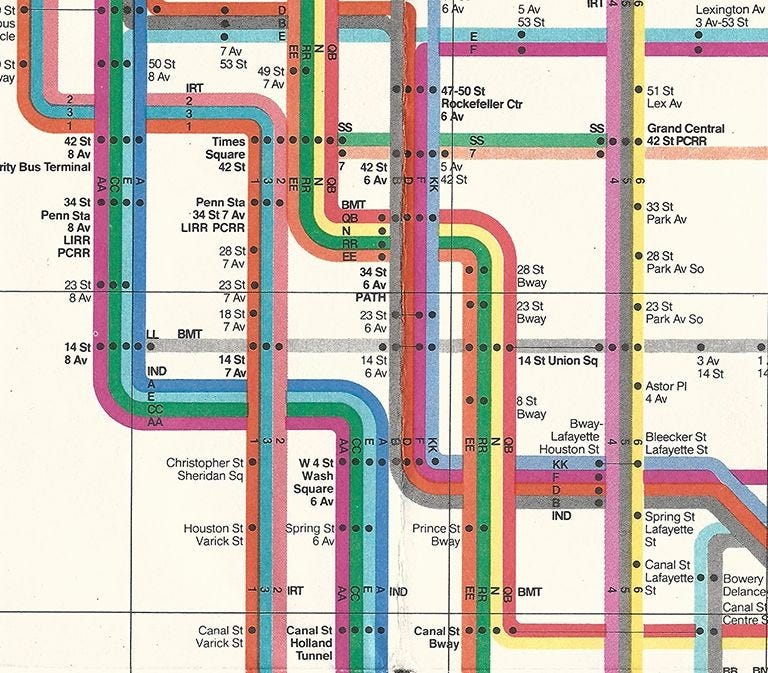
Block by block, it felt like a map was unfolding. That’s the bar where I kissed that boy. That’s the subway station staircase I cried under. That’s the pizza place on the east side where I ate dollar slices at 22 because it was all I could afford and I thought that was the dream—and I was right.
Every block has a timestamp. Every intersection holds something. And I didn’t know that. I didn’t know that living somewhere for twelve years could turn the streets into a kind of autobiography you don’t realize you’ve been writing.
In 1971, a neuroscientist named John O'Keefe discovered something in the hippocampus—the memory bank of the brain. He found neurons that fire only when you enter a specific location. He called them place cells. One neuron for the corner by your apartment. Another for the route to work. Another for the coffee shop. Your brain builds a spatial map of the places you inhabit. Not figuratively. Literally. Neuron by neuron, your brain draws the city inside itself.
There’s a famous study of longtime London taxi drivers. Brain scans showed their posterior hippocampus had physically grown over time. The city reshaped their brains. And the more years they drove, the bigger it got.
I am not a London taxi driver. But for twelve years, my brain has been drawing a map without asking permission. Every opening night. Every 3rd glass of wine. Every hug. Every heartbreak. Every subway ride home from every audition.
There’s another layer—harder to name—that has to do with how a place stops being where you are and starts being who you are. Psychologists call it place identity: the physical environments we inhabit become part of our self-concept. Not as backdrops. As structure. The place tells you: you are the person who lives here. It becomes evidence of your own existence.
And wherever we go, we pick up people the way roots pick up water—not by design, but by reaching toward whatever sustains us. We talk about “putting down roots” like it’s deliberate, like you plant yourself and grow. But roots don’t work that way. They’re opportunistic. They grow toward moisture. They find cracks and fill them. They tangle around whatever is solid enough to hold.
And New York accelerates this. Eight million people in three hundred square miles. You’re stacked on top of each other in apartments and subway cars and theater lobbies. You can’t avoid collision here. The density won’t let you. You meet your future collaborator because you were both waiting for the same bathroom at the same bar. Your friend of a friend of a friend becomes the friend who reshapes your thirties.
My people—the ones I had to hug goodbye—I knew almost none of them twelve years ago. They arrived through side doors. Through accidents. Through introductions that seemed meaningless at the time. That’s not a plan. That’s a root system. That’s what happens when you stay somewhere long enough.
Don’t it always seem to go that you don’t know what you’ve got till it’s gone?
Joni Mitchell was singing about parking lots. But the feeling she named—that something becomes most visible at the moment it disappears—turns out to be more than a lyric.
A psychiatrist named Mindy Fullilove studies what happens when people leave the places that shaped them. She found that when those bonds are disrupted—even voluntarily, even for the right reasons—the attachment doesn’t fade. It intensifies. The unfamiliarity of the new place makes the old one more vivid.
And if that’s true—the real weight of twelve years in this city will arrive after I’ve left it, when I’m three thousand miles away and some song comes on or some smell drifts past and my hippocampus fires up a block I haven’t walked in months and suddenly I’m back on 53rd and 2nd and it’s 2014 and I’m twenty-two and I don’t know anyone and everything is still starting.
The grief and the gratitude might be the same thing. The ache of leaving might be the first clear evidence that the place actually became part of you. You couldn’t feel the weight of the wall while you were leaning on it. You had to step away.
My impulse—my deep, almost cellular impulse—is to control what happens next. To arrive in LA with a framework. A plan for what the new chapter looks like, how I’ll stay connected, what I’ll build, where I’ll put my roots.
But I don’t think roots take instructions. They never did.
I’ve been asking myself all week why this birthday feels different. And I think the answer is that thirty-four, for me, isn’t a milestone. It’s a vantage point. It’s the first time I’ve been high enough to see the whole drawing—every line, every intersection, every mess that turned out to be a miracle.
Maybe that’s the thing about places and times. They become part of you so slowly that you don’t notice. And then you leave, and you notice all at once. And from that distance—from LA, from thirty-four, from the other side of a chapter you can finally read—you realize the question was never whether the city shaped you.
The question is what you do with the shape.
This week in One Last Thing: the thing I didn’t want to write about in this piece—what it means to leave the gravitational center of the thing I write about, and what I’m actually afraid of.
It’s for paid subscribers ($5/month), which helps keep The Fourth Wall alive and independent. Either way, thank you for being here.
One last thing…
There’s a version of this piece I didn’t write. The version where I talk about what it means to write a newsletter about theater—from inside the theater capital of the world—and then leave.